
%2001%201.png)

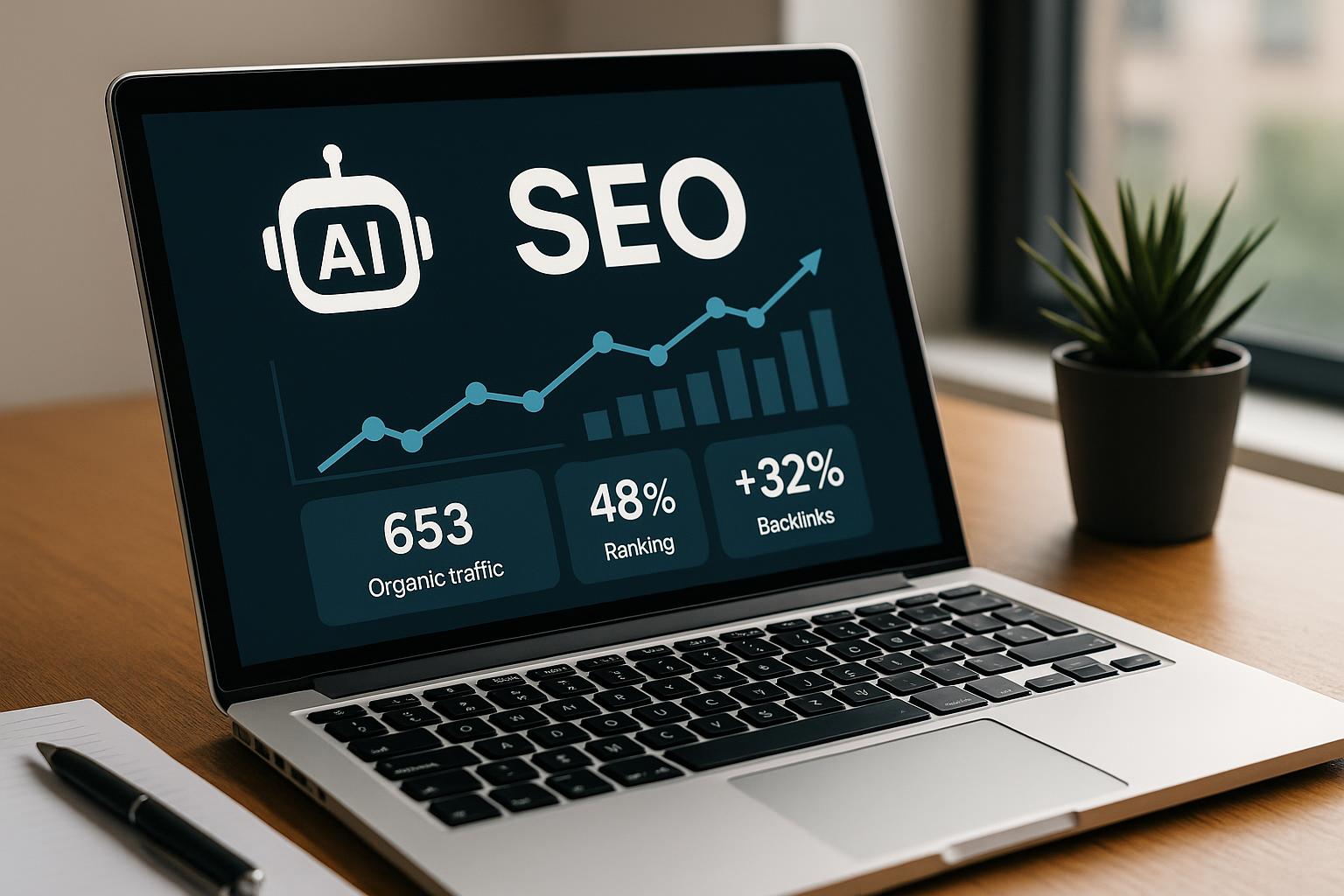
How to Use AI SEO Software: A Beginner's Guide to Automation & Quick Wins
You're staring at a spreadsheet of keywords, and you've already spent two hours researching just the first 50. Your competitor seems to rank for everything, and you're wondering if they've got some secret advantage. Here's the thing—they might just be using AI SEO software to automate the heavy lifting.
If you're a content creator, small business owner, or early-stage marketer navigating the SEO world, you've probably heard the buzz about AI tools claiming to automate everything. But here's what nobody tells you upfront: most of those claims sound too good to be true because you're comparing them to manual work that's genuinely exhausting. AI SEO software actually delivers—when you understand what it does and how to use it.
In this guide, you'll learn exactly what AI SEO software actually does, how to pick the right tool without getting overwhelmed, and—most importantly—how to start seeing real results in your first week. No technical expertise required. No complicated jargon. Just practical, actionable strategies that work for beginners.
What Is AI SEO Software? (Fundamentals Explained Simply)
Core Capabilities: What AI Actually Does for Your SEO
Let's start with the basics. AI SEO software uses machine learning algorithms to automate the repetitive, time-consuming parts of search engine optimization. Instead of you manually researching keywords, analyzing competitor content, and tweaking page titles for hours, the AI processes it in minutes.
Think about keyword research. Manually, you might spend three hours analyzing 100 keyword variations to find the best opportunities for your niche. AI-powered keyword research tools can analyze 1,000 keyword variations in under five minutes, pulling data on search volume, competition level, and intent patterns. The AI then ranks them by actual business potential, not just raw traffic numbers.
Beyond keywords, AI SEO software handles content optimization recommendations, tracks your rankings across search engines, identifies technical issues on your site, and even suggests which existing pieces of content could get the biggest ranking boost with minimal changes. It's like having a junior SEO specialist working 24/7, except it costs a fraction of hiring one.
AI vs. Traditional SEO Tools: Where's the Real Difference?
Traditional SEO tools (think rank trackers, basic keyword tools, or analytics dashboards) give you data. They show you what's happening with your rankings, traffic, and competitor metrics. But you have to interpret that data and decide what to do with it.
AI SEO tools go further. They don't just show you the data—they analyze patterns, predict outcomes, and tell you exactly what action to take next. It's the difference between a thermometer (traditional tools) that tells you the temperature and a thermostat (AI tools) that automatically adjusts the temperature for you.
| Feature | Traditional SEO Tools | AI SEO Software |
| Keyword Research | Manual analysis, limited variations tested | Automated bulk analysis, 1,000+ variations scored instantly |
| Content Optimization | You interpret what needs changing | AI recommends specific changes with priority ranking |
| Rank Tracking | Shows your positions, limited deeper insight | Tracks + predicts future movement based on competitive shifts |
| Time Investment | 3-5 hours per week minimum | 30 minutes per week for most tasks |
| Actionability | Data-heavy, strategy is your responsibility | Recommendations + execution path included |
| Cost | $50-150/month typically | $100-300/month (saves 10+ hours/week) |
The key difference: traditional tools require you to be the strategist. AI SEO software removes the guesswork and hands you a clear roadmap.
Why AI SEO Tools Are Worth Your Attention (Real Benefits Breakdown)
Time Savings: The Hours You'll Get Back
Here's what a typical week looks like for a small business owner doing SEO manually: Monday spent on keyword research (3 hours), Wednesday analyzing competitor content (2 hours), Thursday optimizing existing pages (2 hours), Friday checking rankings and updating a spreadsheet (1.5 hours). That's 8.5 hours—roughly a full business day—every single week.
With AI SEO software automating these tasks, that same workflow compresses to about 1.5-2 hours per week. The AI handles keyword research (15 minutes), competitor analysis is mostly automated (20 minutes to review AI-generated insights), and rank tracking is passive monitoring. You're left with just strategic decision-making and content creation—the parts that actually move the needle.
Over a year, that's 300+ hours freed up. Depending on your hourly rate, that's anywhere from $3,000 to $15,000+ in time value—before you even factor in improved rankings or increased traffic.
Better Rankings, Smarter Strategy
AI doesn't just save time—it identifies opportunities you'd miss working manually. These tools analyze search patterns across millions of queries to reveal gaps: keywords your competitors rank for where you have zero visibility, long-tail variations with high intent but low competition, and content optimizations that would push you from position #8 to position #3 with minimal effort.
One real example: a digital marketing agency used AI SEO software to analyze their existing blog content. The AI flagged 12 articles already ranking on page two for high-value keywords. By implementing the AI's optimization recommendations (new subheadings, keyword density adjustments, internal linking suggestions), they moved 8 of those articles to page one within 45 days, resulting in a 30% increase in organic traffic with zero new content created.
Cost Efficiency & ROI You Can Measure
Let's talk about the financial side, because that's what matters for your business decision. An AI SEO tool costs between $100-300 per month depending on features. Hiring a freelance SEO specialist or agency costs $2,000-10,000+ monthly. Even if you only use the tool to save 10 hours per week at $50/hour, you're looking at $2,000/month in value for a $150 tool. That's a 13x ROI before your rankings improve.
Once your rankings improve and organic traffic increases, the ROI compounds. An additional 1,000 organic visitors per month is worth approximately $1,000-5,000 depending on your conversion rate and average customer value. Most businesses see a 2-3x return on their AI SEO software investment within 90 days, just from improved rankings and increased organic traffic.
Within two months the tool paid for itself six times over—once through time savings alone, and three more times through additional organic revenue. It's been one of our best business investments.-
How to Choose the Right AI SEO Software for Your Needs
Key Features That Actually Matter (For Beginners)
When you're researching AI SEO tools, the feature lists can feel overwhelming. One tool brags about 500+ integrations, another promises AI-powered predictive analytics, and a third claims machine learning for content sentiment analysis. Here's what actually matters if you're just starting out:
- Keyword research automation: Can it analyze search volume, competition, and intent at scale?
- Content optimization suggestions: Does it tell you what to change on your pages to rank higher?
- Rank tracking: Can it monitor where you rank for your target keywords across search engines?
- Competitor analysis: Does it show what keywords competitors rank for that you don't?
- Technical SEO audits: Can it scan your site and flag issues (broken links, mobile problems, etc.)?
- Reporting & dashboard: Is the interface actually understandable, or will you need technical training to read it?
- Support & documentation: If you get stuck, can you actually get help without waiting weeks?
Everything else is nice-to-have. Skip the tools with flashy features you won't use. Focus on these core AI SEO capabilities, and you'll be 80% of the way to success.
Budget Considerations & Feature Matching
AI SEO tools typically fall into three price tiers. The starter tier ($100-150/month) is perfect for freelancers, solopreneurs, and small businesses—you get the core features (keyword research, rank tracking, basic optimization suggestions). The mid-tier ($200-300/month) adds advanced competitor analysis, content optimization for multiple pages, and more detailed reporting. The enterprise tier ($500+/month) is for agencies and larger teams managing dozens of keywords and clients.
Honest advice: start with the starter tier. You don't need advanced features until you've actually implemented the basics and proven you can execute an SEO strategy. Most users find 80% of their value in the entry-level packages. You can always upgrade once you've demonstrated results and justified the extra spend to your budget.
Integration & Setup Complexity: Will You Actually Use It?
The best AI SEO software in the world is useless if it's too complicated to actually use. Before you commit, check whether the tool integrates with platforms you already use: Google Analytics, Google Search Console, WordPress, Shopify, or HubSpot.
Also verify the setup process. Can you create an account and run your first keyword analysis within 30 minutes, or does it require a technical setup call? Good tools are designed for beginners. If the onboarding feels overwhelming, that's a red flag.
Check one more thing: customer support availability. Email-only support is fine for occasional questions, but if you hit a problem during your first week, you want access to live chat or a phone number. Most AI SEO tools worth using offer at least chat support during business hours.
Step-by-Step Implementation: Getting Started in 30 Minutes
Tool Setup & First Campaign Configuration
Step one: Sign up and connect your website. Most tools ask you to verify ownership by adding a small code snippet to your site header or through Google Search Console. This takes about five minutes and gives the AI permission to analyze your site and track rankings.
Step two: Add your target keywords or let the tool import them from Google Search Console (where you'll see queries people already search for that land on your pages). If you don't have existing keywords yet, don't worry—the next section covers how to find them using AI automation.
Step three: Configure rank tracking. Select the search engines you care about (Google is the priority for most businesses), set your geographic location if you're targeting local search, and activate tracking. The tool will begin monitoring your rankings and storing the data automatically.
That's it. You're live. Total time: about 10-15 minutes.
Your First AI Keyword Research: Finding Quick-Win Opportunities
Now comes the fun part. Open the keyword research module and tell the AI about your business. Most tools ask: What do you do? Who's your target audience? What keywords do you currently rank for (if any)? Based on your answers, the AI generates a list of keyword opportunities ranked by potential.
Look for the 'opportunity score'—this is AI's rating of how valuable each keyword is for you specifically. High opportunity means the keyword has decent search volume, low competition, and aligns with your business. These are your quick wins. Ignore the vanity keywords with massive search volume but impossible competition.
Pick 5-10 keywords from the opportunity list. These become the foundation of your first campaign. Don't overthink it—the AI did the heavy lifting. Your job is just to make sure they're relevant to what you actually offer.
Monitoring Your Dashboard & Reading the Metrics That Matter
Once your campaign is live, focus on three key metrics in your dashboard: overall visibility (what percentage of your target keywords you rank for), average ranking position (where you sit on average across all tracked keywords), and organic traffic growth (visitors coming from your tracked keywords).
Check your dashboard weekly, not daily. SEO changes take time. You're looking for trends over 2-4 weeks, not daily fluctuations. When you spot a keyword that's climbed from position #15 to #8 in two weeks, that's a win. When you see ranking drops of more than three positions, click into that keyword to see if a competitor made changes or if your page content drifted from the topic.
Ignore vanity metrics like 'domain authority' or 'backlink count'—these are less actionable for beginners. Focus on rankings, visibility, and traffic. That's what actually impacts your business and revenue.
Real Case Studies: Time Saved & ROI Metrics You Can Expect
Case Study #1 – Content Creator (Time-Focused ROI)
Sarah is a freelance content writer specializing in SaaS copywriting. She spent 8-10 hours per week on SEO tasks: researching keywords for articles, analyzing competitor content to understand ranking factors, and manually checking her rankings in a spreadsheet. In short, SEO was eating into her billable hours.
After implementing an AI SEO tool: Sarah reduced her SEO time to 1.5 hours per week. The tool automated keyword research (now 15 minutes), provided optimization recommendations she could apply while writing (reducing that time from 2 hours to 30 minutes), and eliminated the ranking spreadsheet entirely. Over six months, she reclaimed 30 billable hours—roughly $3,000 in additional revenue capacity. Plus, her organic traffic grew 45% because her content was properly optimized for search intent from day one.
Bottom line: Time savings of 6.5 hours per week = $3,000 direct revenue impact over 6 months, plus traffic growth enabling high-value client partnerships. ROI: 1000%+ in the first year.
Case Study #2 – Small E-Commerce Business (Revenue-Focused ROI)
Marcus runs a small e-commerce store selling premium kitchen knives. His baseline: 200 organic visitors per month, mostly from branded keywords. He was paying $120/month for a rank tracker but wasn't taking action on the data—he lacked time to optimize his product pages or create content around target keywords.
After six months with AI SEO software: Marcus identified 15 high-intent keywords his competitors ranked for but he didn't. He optimized existing product pages (10 hours total) and created three comparison guides targeting high-value keywords. His organic traffic grew from 200 to 800 visitors per month. At a 2.5% conversion rate and $80 average order value, that's an extra $480/month in revenue. The tool cost $150/month, leaving $330/month net profit—a 220% ROI in month six alone.
The real win: Marcus freed up 10-12 hours per month he was previously 'trying' to do SEO, and those hours now generated measurable revenue. Year one ROI: 400%+.
Before/After Comparison: What Changes in 90 Days
Here's what a realistic 90-day timeline looks like for most beginners using AI SEO software:
| Timeframe | What Happens | Key Metrics |
| Week 1-2 | Setup + first keyword research + optimization of 2-3 existing pages | 0 ranking changes (Google needs 2-3 weeks to re-crawl) |
| Week 3-4 | Google re-crawls optimized pages; you create first AI-optimized content piece | 2-5 keywords move up 2-3 positions; new content starts getting indexed |
| Week 5-8 | Continue optimizing existing content; create 2-3 more target keyword articles; monitor ranking shifts | 5-10 keywords ranking in top 10; organic traffic up 15-25% from baseline |
| Week 9-12 | Build momentum: optimize lower-ranking pages; pursue content gaps; implement AI recommendations on high-traffic pages | 10-15 keywords in top 10; organic traffic up 40-60% from baseline; 2-5 keywords breaking into top 3 |
These are averages from small businesses using AI SEO tools properly. Your timeline may vary depending on your industry competitiveness and starting point, but the pattern typically holds: first results in 3-4 weeks, significant momentum by week 8.
Quick Wins: 3 AI SEO Strategies You Can Launch This Week
Strategy #1 – AI-Powered Content Gap Analysis (Time Saved: 4-5 Hours)
Here's your first quick win: Use your AI tool's competitor analysis feature to find content topics your competitors rank for that you don't. The tool identifies these 'content gaps'—keywords with real search volume where you have zero visibility.
Action: Pick one high-opportunity gap keyword (AI ranks them for you). Create one 1,000-1,500 word piece of optimized content using the AI's on-page recommendations. Publish it. The AI predicts you'll rank between position #5-#12 within 30-45 days (assuming your domain has some existing authority). That's one new ranking on day one of your campaign.
Why it works: You're not starting from zero—your competitors already proved the keyword has value. You're just filling a gap they left open. Manually researching competitors, analyzing their content, finding gaps, and outlining your article would take 4-5 hours. The AI does it in 30 minutes.
Strategy #2 – Rapid Keyword Expansion for Existing Content (Time Saved: 3-4 Hours)
You probably have existing blog posts or pages already published. Your second quick win: Use the AI tool to identify related keywords you're not currently optimizing for—long-tail variations and semantic matches that could drive additional traffic to pages you've already created.
Action: Pick your best-performing page (highest traffic or most engaged readers). The AI analyzes it and suggests 10-15 related keywords you could optimize for with minimal changes. Update that page's subheadings, add a FAQ section addressing search variations, and refresh the internal linking. Manually finding these keyword opportunities would take 3-4 hours of searching and analysis. The AI does it in 10 minutes.
Expected result: Within 2-3 weeks, your page starts ranking for 5-8 additional keywords it wasn't targeting before. Traffic multiplier: 30-50% increase on that single page with zero additional content created.
Strategy #3 – Automated On-Page Optimization (Time Saved: 2-3 Hours)
Your third quick win is the simplest: Pick any published page you want to improve. Run it through the AI tool's on-page optimizer. The tool analyzes your page against your target keyword and competitors' top-ranking content, then generates specific recommendations: adjust your title tag, rewrite meta description, restructure your H2s, add keyword mentions in opening paragraph, improve internal linking, etc.
Action: Implement 5-7 of the AI's highest-priority recommendations. Don't overthink it—these are data-driven changes based on what's ranking. Manually analyzing competitor pages and figuring out what to change would take 2-3 hours. The AI gives you the roadmap in 15 minutes.
Expected result: Average ranking lift of 2-4 positions within 3-4 weeks. If your page was ranking at position #8, expect to hit #5-#6. If it was at #15, expect #10-#12. Each position move is roughly a 10-20% traffic increase on average.
The thing I love about these AI SEO strategies is you can execute all three in your first week and start seeing real traction immediately. It's not a six-month waiting game—you get wins fast, which keeps you motivated.-
Common Mistakes Beginners Make (And How to Avoid Them)
Chasing Vanity Metrics Over Real Business Goals
The biggest beginner mistake: optimizing for keywords with huge search volume that don't convert. You get excited that 'AI kitchen knife sharpening tips' has 5,000 monthly searches, so you optimize an entire piece around it. You rank on page one. No sales. Why? Because people searching that phrase are looking for free YouTube videos, not to buy your $200 knife sharpening service.
Fix: Focus on keywords with business intent. Look for terms people search when they're actually ready to buy, hire, or sign up. AI tools help you identify intent—pay attention to that scoring. Don't just chase search volume.
Neglecting Regular Monitoring & Optimization
Myth: AI SEO tools are set-it-and-forget-it. Reality: They're a starting point, not a complete solution. You still need to actually create content, monitor ranking progress, and adjust strategy based on what's working.
Fix: Check your dashboard weekly. If a keyword is dropping in rankings, investigate why. Did a competitor publish new content? Did Google's algorithm shift? Do you need to refresh your content or improve technical aspects? The AI gives you recommendations, but human judgment decides implementation.
Overstuffing Keywords & Ignoring User Experience
Rookie mistake: The AI suggests your target keyword should appear 8-10 times in a 1,000-word article, so you cram it in every other sentence. Your writing becomes stilted and awkward. Readers bounce. Google notices the bounce rate and actually drops your ranking.
Fix: The AI's keyword density recommendations are ceilings, not mandates. Your primary goal is writing for humans. If naturally using your keyword 4-5 times in the article creates better-flowing content, do that. Readability beats keyword perfection every time. Google's algorithm now heavily weighs user experience signals like time-on-page and bounce rate—writing for AI instead of humans will backfire.
Final Thoughts: You've Got This
Let's recap what we covered. AI SEO software automates the repetitive, time-consuming parts of search optimization. It saves you 6-8 hours per week, helps you find better ranking opportunities, and delivers measurable ROI—often within the first 90 days. You don't need technical expertise to use these tools successfully. Most beginner-friendly AI SEO tools will have you set up and running your first campaign in 30 minutes.
The three quick-win strategies we covered—content gap analysis, keyword expansion for existing pages, and on-page optimization—are practical tactics you can execute this week. Each one delivers time savings and ranking improvements without requiring a complete SEO overhaul.
The honest truth: You probably won't see massive results overnight. But if you follow the 90-day timeline, implement the strategies consistently, and monitor your progress weekly, you'll see meaningful organic traffic growth and ranking improvements that translate to real business results.
You're not behind. You don't need to be a technical wizard. All you need is a tool that removes the noise and shows you exactly what to do next—and that's what AI SEO software does.
Ready to get started? Pick one AI SEO tool that fits your budget, sign up for the free trial, and run through the setup. Spend 30 minutes this week implementing your first quick-win strategy. That's all it takes to prove to yourself that AI SEO automation actually works.
Start your first AI SEO campaign free today – with a 14-day free trial, no credit card required. See real results from AI-powered automation before you commit to anything.
Frequently Asked Questions
Do I really need AI SEO software, or can I just do SEO manually?
You can do SEO manually, but it takes 8-10 hours per week and you'll still miss optimization opportunities that AI catches instantly. Think of it this way: you can drive nails into a wall with a rock, but a hammer is faster and more effective. AI SEO software is the hammer. If you have the time and enjoy detailed analysis, manual SEO works. If you want results faster and want to reclaim your time, an AI tool pays for itself within months.
What if I have a very niche business? Will AI SEO software still work?
Yes, especially in niche businesses. AI tools often find the most value in underserved niches where there's less obvious competition data and more hidden keyword opportunities. Your niche might have less overall search volume, but the conversion intent is often higher. AI tools excel at finding these pockets of opportunity that manual research misses.
How long before I see ranking changes?
Google typically needs 2-3 weeks to re-crawl and re-index your optimized pages. You might see small ranking movements at day 14-21, but meaningful shifts usually happen by week 4-6. For brand new content, expect ranking appearance by day 20-30, with position improvements happening over the following 4-8 weeks. Remember: SEO is a marathon, not a sprint.
Is AI-generated content a problem for SEO?
AI-generated content alone, without human editing and expertise, can be mediocre. But AI content that's edited, fact-checked, and enhanced by human expertise performs fine in search. The key is not publishing raw AI output—use AI as a starting point, then edit heavily for uniqueness, accuracy, and value. Your content should reflect your genuine expertise and perspective, with AI handling the initial draft heavy lifting.
Can I use AI SEO software for multiple websites or clients?
Most tools offer project-based management where you can track multiple websites on a single account. If you're managing dozens of client sites, you might eventually need an agency or enterprise plan, but the starter tier typically handles 2-5 sites before you need to upgrade. Check your specific tool's documentation on site limits.
What happens to my rankings if I stop using the AI SEO tool?
Your rankings don't instantly drop. The AI tool just stops providing optimization recommendations and tracking updates. Your optimized content stays optimized, and your rankings remain until competitors optimize better or Google updates its algorithm. Think of the tool as a strategic advisor—stop consulting it, and your strategy stalls, but your existing position doesn't disappear immediately.

.png)