%2001%201.png)

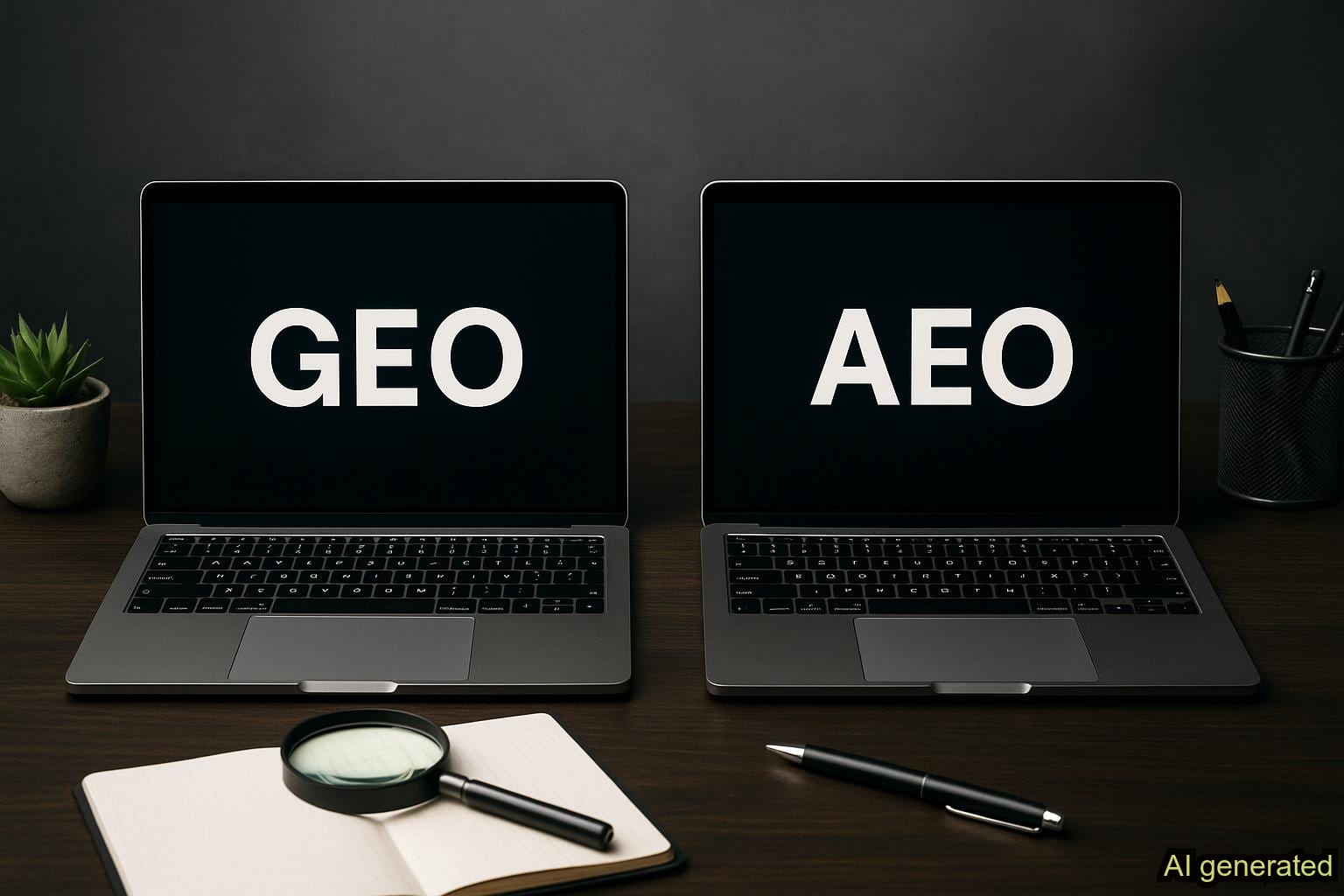
GEO vs AEO: Which SEO Strategy Should You Choose as a Solo Founder?
You know the SEO tools exist. You've read the Reddit threads, watched the YouTube tutorials, and deep down you know you can figure this out on your own. But here's the thing: you're seeing GEO and AEO mentioned everywhere, and you have no idea which one actually matters for your business right now. Should you focus on local search dominance? Or should you chase AI search rankings? Both sound important. Both sound urgent. And you're stuck wondering which one won't drain your limited time and resources.
The good news? GEO vs AEO isn't an either-or decision. Geographic SEO and AI Engine Optimization are two distinct strategies that serve different founder goals at different stages. One gets you found by people searching locally right now. The other positions you as an authoritative source that AI systems recommend to users worldwide. By the end of this guide, you'll understand exactly which strategy fits your current stage, how much work each one actually requires, and how to sequence both without losing your mind.
Let's cut through the confusion so you can start optimizing this week and stop second-guessing your SEO strategy.
What is GEO (Geographic SEO)?
Geographic SEO, or GEO, is the practice of optimizing your online presence so you rank for searches tied to specific locations. When someone searches "plumber near me" or "best coffee shop in Brooklyn," they're expressing geographic search intent. GEO is about making sure your business appears in those results, for those specific people, in those specific places.
How Geographic SEO Works
Geographic SEO relies on a few core mechanics. First, you optimize your Google Business Profile with accurate business information, high-quality photos, and a compelling description. Second, you target location-specific keywords like "consulting services Denver" instead of just "consulting services." Third, you create content that signals local relevance, like blog posts about your specific market or neighborhood. Google uses location signals like your business address, phone number, customer reviews, and geographic language in your content to determine if you're a strong match for local searches.
Here's a concrete example: You're a solo marketing consultant in Austin. Someone in Austin searches "fractional CMO Austin." Because you've optimized your Google Business Profile, claimed your local business listings, and written blog posts specifically about marketing for Austin startups, Google recognizes you as a local authority. You show up in their results, they call you, and you land a client.
Real-World Applications for Solo Founders
- Local service businesses like plumbing, accounting, personal training, or consulting, where clients specifically search by location and need immediate availability
- Neighborhood-focused e-commerce businesses selling local artisan products or handmade goods where geographic identity strengthens your brand
- Regional expertise positioning where you specialize in a specific city or region and want depth within that market over broader reach
GEO strategy shines when your customer base needs to find you locally and soon. You see traction fast because Google heavily prioritizes location signals in local search results, making geographic SEO the quickest path to qualified, nearby customers.
What is AEO (AI Engine Optimization)?
AI Engine Optimization, or AEO, is optimization designed to get your content cited and recommended by AI search systems. Instead of someone typing "project management for remote teams" into Google, they're asking ChatGPT, Perplexity, or Claude: "What's the best way to manage a remote team?" AEO is about positioning your content to be the source that AI systems quote or reference when answering those questions.
AI Engine Optimization differs from traditional SEO because AI search engines reward different ranking factors. They prioritize content that directly answers questions, uses semantic language naturally, provides clear frameworks and structure, and demonstrates genuine subject matter expertise. You're not competing for a top 10 ranking position. You're competing to be the authoritative source AI chooses to recommend.
How AI Engine Optimization Works
AEO works by structuring your content to answer questions comprehensively and semantically. AI models scan the web looking for authoritative, well-organized answers to common questions. If you write a guide titled "5 Proven Strategies to Reduce Customer Churn" with clear sections, data, actionable frameworks, and real examples, an AI searching for churn reduction content is more likely to cite you than a competitor with vague or shallow content.
Here's how it works in practice: You're a SaaS founder writing about product onboarding. Instead of a generic post, you write "Product Onboarding Best Practices: A 7-Step Framework for Reducing Time-to-Value." You include clear, numbered steps, specific examples from your experience, measurable metrics, and downloadable templates. When someone asks ChatGPT "How do I get users productive faster?", your content becomes a candidate for citation because it's structured, authoritative, and directly solves their problem. They see your name in the AI response and click through to learn more.
Real-World Applications for Solo Founders
- Thought leadership and expertise content where you want to be recognized as an authority across global audiences, not just your local market
- Knowledge-based products or services like B2B SaaS, online courses, or consulting frameworks where customers research problems before making buying decisions
- Global reach ambitions where your customer base spans multiple geographies and you want to be discovered by anyone, anywhere asking questions in your industry
AEO is your strategy when you're playing the longer game. You want to build authority globally, reach audiences beyond geographic limits, and earn recognition as a trusted source that AI systems consistently recommend to their users.
GEO vs AEO: Head-to-Head Comparison
Side-by-Side Comparison Table
| Factor | GEO (Geographic SEO) | AEO (AI Engine Optimization) |
| Implementation Effort | Low to Medium. Google Business Profile setup, local keyword targeting, 3-5 location-based blog posts. | Medium to High. Requires well-researched, comprehensively structured content with frameworks and data per article. |
| Time to First Results | 2-4 weeks for Google Business Profile impressions; 4-8 weeks for meaningful local rankings | 1-2 weeks for first AI mentions if content is strong; 2-3 months for consistent, reliable citations |
| Resource Requirements | Minimal. Solo-friendly. 4-6 hours setup, 2-3 hours monthly maintenance. | Moderate to High. 8-10 hours per cornerstone piece plus 3-5 hours monthly for supplementary content |
| Best For | Local services, neighborhood businesses, regional expertise, fast local customer acquisition | Global reach, thought leadership, knowledge products, long-term authority and brand building |
| ROI Timeline | Fast. 60-90 days to qualified leads from local search. | Medium. 3-6 months to consistent AI citations and referred traffic. |
| Tool Complexity | Simple. Google Business Profile, Search Console, basic keyword research tools. | Moderate. Semantic keyword research and AI-specific content optimization tools recommended. |
Speed to Results and Resource Requirements
Here's what actually matters to you as a solo founder: time and effort. GEO wins on speed. You can get your Google Business Profile live and start seeing search impressions within 2-4 weeks. Local rankings take 4-8 weeks of consistent work, but the actual lift is light. You're spending 4-6 hours on setup and maybe 2-3 hours per month on maintenance, reviews, and monitoring.
AI Engine Optimization requires more upfront work but compounds over time. Your first AI mentions might come within 1-2 weeks if your content is genuinely strong, but building consistent citations requires sustained effort. You need to produce high-quality, research-backed content regularly. Plan on 8-10 hours per cornerstone piece plus 3-5 hours monthly for related content pieces. The payoff is that you're building a searchable library of content that AI systems consistently reference, and that visibility grows month after month.
The real resource constraint for most solo founders isn't budget, it's time. If you need customers within the next quarter and you're locally focused, geographic SEO offers the shorter path to results. If you're playing a longer strategy or aiming for global reach, AEO is worth the heavier upfront investment.
Which Strategy Should You Choose? A Decision Framework for Your Stage
Decision Framework by Business Stage
Your business stage matters far more than industry hype. Here's how to think strategically about GEO vs AEO at different growth phases:
- Pre-launch or zero customers: Choose GEO if you serve a specific geographic market and can build local reviews and word-of-mouth momentum quickly. Choose AEO if your potential customers are scattered across geographies and you're building thought leadership as your primary entry point.
- Post-launch with initial local customers: GEO accelerates growth immediately. Double down on geographic SEO strategy. Optimize your local listings, collect reviews, and own local keywords. You'll see ROI faster than virtually any other marketing channel.
- Scaling regionally or nationally: You need both strategies working together eventually. Start with geographic SEO in your primary market to validate the model and build social proof. Then layer in AEO content to reach audiences beyond your local area.
- Building thought leadership or selling expertise: AEO becomes your foundation. Your content IS your product. You're competing for global mindshare, not customers in one neighborhood, and AI citations build that authority.
Ask yourself this: Where do my ideal customers search? If they type "plumber near me" or "accountant in my city," geographic SEO strategy is your priority. If they ask AI chatbots questions about industry trends or best practices before talking to a salesperson, AEO is your priority. Most founders eventually need both. The real question is which to prioritize first based on your current stage and available resources.
How Both Strategies Work Together
Here's the insight that changes everything: GEO vs AEO isn't an either-or dilemma. It's about sequencing based on your current stage and resources. You can master one strategy, then layer in the other without duplicating effort or creating competing priorities.
Here's a practical playbook: If you're local, start with geographic SEO. Spend your first 8-12 weeks optimizing your Google Business Profile, collecting genuine customer reviews, and targeting local keywords. Get 5-10 qualified customers through local search. Build momentum and credibility. Then, while you're running the business and those customers are generating word-of-mouth, start layering in AEO. Write one cornerstone content piece per month that answers industry questions and builds your authority. Over 6-12 months, you're getting traction from both channels with minimal additional effort once GEO runs on autopilot.
Using a unified platform like RankRealizer lets you manage both GEO and AEO strategies from one dashboard. You're not juggling five different SEO tools, confused by conflicting data, or duplicating optimization work across platforms. One platform tracks your local keywords, optimizes your Google Business Profile, scores your content for AI search readiness, and monitors AI mentions. Less tool clutter. More time actually building your business.
How to Implement Both Strategies as a Solo Founder
Quick-Start Implementation Checklist
You don't need to be an SEO expert to start implementing these strategies effectively. Here's exactly how to launch either approach this week without overwhelming yourself.
GEO Quick-Start Checklist: Start here if you serve a local market (Time investment: 4-6 hours setup, 2-3 hours monthly)
- Claim and fully optimize your Google Business Profile. Add high-quality photos, a detailed business description, your service area, business hours, and every optional field. Spend 90 minutes here getting this foundation right.
- Identify 5-10 local keywords your actual customers search. Examples: "plumber Denver," "fractional CFO Austin," "dog trainer Brooklyn." Use Google Search Console or free Google Keyword Planner to confirm real search volume.
- Write 3-5 location-based blog posts (500-800 words each) over the next 4-6 weeks. Topic ideas: "Best X in [City]," "[Service] for [City] Businesses," "How to Choose an X in [City]." These signal local relevance to Google.
- Ask your first 5-10 customers for Google reviews. Send them a direct link and make it frictionless. Respond thoughtfully to every review. This builds social proof and signals active local business presence.
- Set up Google Search Console and check your impressions, clicks, and average position for local keywords weekly. Adjust content based on performance to improve your rankings over time.
AEO Quick-Start Checklist: Start this once geographic SEO is running smoothly (Time investment: 8-10 hours per content piece, then 3-5 hours monthly)
- Identify 3-5 core questions your ideal customers ask before buying or when researching your industry. Examples: "How do I know if I need a fractional CFO?" "What should I look for in project management software?" "How do I improve customer retention?" These become your AEO content anchors.
- Write one comprehensive cornerstone piece (1,500-2,500 words) answering one question thoroughly. Structure it with clear sections, frameworks, data, examples, and templates. Make it the definitive guide someone could find. Invest 4-6 hours in research and writing.
- Optimize for semantic relevance and AI search readiness. Use natural variations of your topic throughout. AI systems reward content that covers related concepts and comprehensively addresses a topic.
- Supplement with 2-3 shorter pieces (500-800 words) over the next month diving into specific aspects of your main piece. Link them back to your cornerstone content. This signals topical expertise to AI systems.
- Monitor AI search results for your content every 2-3 weeks. Search your topic in ChatGPT, Perplexity, or Claude and note whether your content is cited. Adjust your approach based on what's working.
The key takeaway: You're not picking GEO or AEO and abandoning the other permanently. You're choosing which to start with based on your immediate business need, then adding the second strategy once the first is delivering results and running relatively automatically. A local service business starts with geographic SEO and adds AI Engine Optimization later. A knowledge business starts with AEO and adds geographic SEO if they expand locally. The choice is about tactical sequencing, not permanent commitment.
Your Clearer Path Forward
You came here unsure about GEO versus AEO strategy. Here's what you should remember: Geographic SEO gets local customers fast but doesn't scale beyond your geography. AI Engine Optimization builds long-term authority and reaches global audiences but requires more sustained content effort. You don't have to choose between them forever. You have to sequence them strategically based on your current business stage.
If you're local and need customers in the next 90 days, prioritize geographic SEO strategy first. If you're building a global brand or selling expertise and ideas, prioritize AEO first. If you're scaling beyond one market, you'll eventually need both strategies working together. The competitive advantage comes from using a unified platform that handles both approaches without forcing you to switch between tools and manage separate dashboards.
You don't need to be an SEO expert to execute this successfully. You just need clarity on what each strategy does, how much work it requires, and which one fits your current stage. Now you have that clarity. Pick your starting point. Follow one of the checklists above. Start this week. You've got this.
Be found in AI search with RankRealizer. Start your free trial with 2 articles free, no credit card required.-


.png)