%2001%201.png)

Google Search Console Setup Guide for Solo Founders: From Data Collection to Action
Why Google Search Console Setup Feels Overwhelming
SEO can be a hassle, especially if you're a solo founder looking to automate your marketing processes—but stuck at 'Where should I begin?' You know Google Search Console is powerful. You've read the blog posts, watched the YouTube tutorials, and you know you can figure it out. But here's the thing: setting it up is one thing. Understanding what all those numbers actually mean? That's where most solo founders hit a wall.
You're sitting there thinking, 'I have all this data, so why do I still feel lost?' The real gap isn't between setup and understanding—it's between understanding your current performance and knowing what to do next. Google Search Console shows you clicks, impressions, average position, and CTR. But it doesn't tell you which keywords to chase, where your competitive opportunities hide, or how to turn raw metrics into a winning strategy. You're at the right place. This guide walks you through setup, helps you decode those metrics, and bridges the gap to actual keyword strategy—so you move from 'I see the data' to 'Here's exactly what I'm optimizing next.'
Getting Started: Google Console Setup in 5 Minutes
Learning how to use Google Search Console doesn't require a technical degree. These three steps will have you collecting performance data faster than you think.
Step 1—Link Your Website to Google Search Console
Head to search.google.com/search-console and sign in with your Google account. Click 'Add Property' and enter your website URL. Google will give you several verification options: domain verification (best for established sites), HTML file upload, HTML tag, or Google Analytics connection if you already use it.
The fastest path for most solo founders? If you've already installed Google Analytics, authenticate it and you're done in 10 seconds. If not, the HTML tag method takes 30 seconds—just paste one line of code into your site's header. Pick whichever feels most natural for your setup.
Step 2—Verify Your Property & Wait for Initial Data
After verification, Google needs 24–48 hours to start collecting search performance data. This is completely normal—you're not missing anything if your dashboard looks empty for a day or two. Google is working in the background, tracking every impression and monitoring click-through rates on your pages.
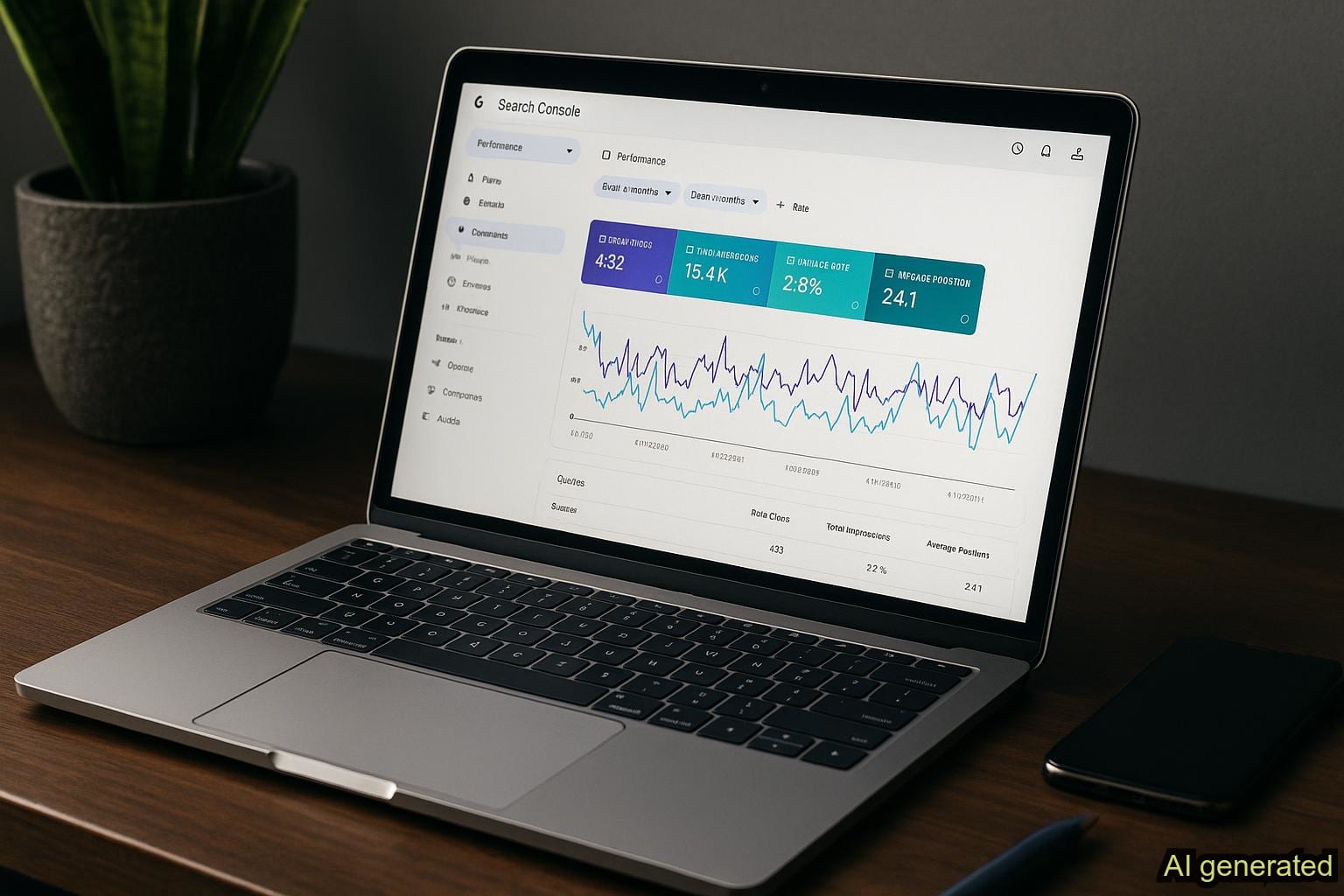
While you wait, explore the Console layout. Open the Performance tab and get familiar with Coverage, Enhancements, and Experience sections. You'll return to these soon enough, so a quick mental tour saves time later.
Step 3—Understand Your Console Dashboard Layout
Google Search Console can feel overwhelming at first glance, but as a solo founder, focus on the sections that directly impact your rankings and traffic.
| Dashboard Section | What It Shows | Why It Matters for You |
| Performance | Clicks, impressions, average position, and CTR across all queries and pages | Your primary hub—where you find quick wins and understand what's actually working |
| Coverage | Pages Google can or cannot crawl and index | Catches technical issues blocking your pages from ranking |
| Enhancements | Mobile usability, rich results eligibility, Core Web Vitals | Highlights user experience problems affecting both rankings and visitor satisfaction |
| Experience | Real-world user experience metrics (mobile, desktop, web vitals) | Shows how actual visitors interact with your site—directly tied to conversion rates |
| Links | Backlinks pointing to your site and your top linked pages | Reveals your link profile and potential broken or low-quality backlinks to fix |
Don't try to master everything at once. Focus on the Performance tab first—that's your money maker. The other sections matter, but performance is where you'll find your immediate optimization opportunities.
Reading Your Performance Dashboard: Core Metrics Explained
Interpreting search console metrics feels abstract until you see what each number actually represents in your business. Let's decode the metrics that matter and turn them into real actions.
Understanding Clicks, Impressions & Click-Through Rate (CTR)
Three metrics dominate the Performance dashboard, and understanding how they work together is half the battle. Impressions = the number of times your page appeared in Google search results. Clicks = how many people actually visited your site from those results. CTR (Click-Through Rate) = clicks divided by impressions, expressed as a percentage.
Here's where it gets actionable: if you're getting 1,000 impressions but only 50 clicks, your CTR is 5%. For pages ranking in positions 3–5, this is a red flag—most achieve 15–20% CTR. Low CTR means one thing: your title tag or meta description isn't compelling enough to make people click. This is fixable. You don't need more traffic—you need a rewrite. A stronger title or more intriguing description can double your clicks without changing your rankings.
Average Position & What It Reveals
Average Position often confuses people. You might see position 3.2—that doesn't mean you're exactly #3. It means across all searches for that keyword (accounting for different devices, locations, and user queries), you average around position 3. Some days you're #2, some days #4.
Why does this matter? It reveals your optimization priorities. Pages in positions 3–5 are your quick wins—one content refresh or better internal linking could push them to #1 within weeks. Pages at position 10+ need comprehensive rework. But those #3–#5 positions? That's where your effort pays off fastest. Use this insight to prioritize which pages to improve first.
Identifying Your Top Performers & Problem Pages
Filter your Google Console data to surface patterns. Go to the Performance tab and sort by Clicks (highest first). These are your money-makers—pages converting searchers into visitors. Note what they have in common: topic depth, format, word count, internal link structure. Then replicate this pattern on other pages.
Next, sort by Impressions (highest first) but filter for low CTR pages. These are the problem cases—high visibility, low conversion. The fix is straightforward: rewrite your title tag and meta description to be more compelling. This approach to interpreting search console metrics helps you maximize your time by tackling the highest-impact optimizations first.
The Critical Question: What Do I Do With This Data?
This is where most solo founders get stuck. You've set up Google Search Console, collected weeks of data, reviewed the numbers. Now what? Having information doesn't equal having a strategy. Let's close that gap by translating metrics into concrete actions.
From Raw Metrics to Actionable Insights
Google Console data becomes powerful only when you translate it into decisions. Here are four real scenarios you'll encounter—and exactly what to do about each one:
- High impressions, low CTR: Your page is visible but not compelling. Action: Rewrite your title tag and meta description to include a benefit or curiosity hook. Measure results within 2 weeks.
- Pages ranked 3–5, high impressions: You're in the sweet spot. Action: Add more depth, improve readability, strengthen internal links to push toward #1.
- Tons of impressions on branded keywords: You're capturing easy traffic (your own brand name). Action: Build from there by targeting informational keywords that funnel new people into your brand.
- Very few impressions overall: Either Console needs more time to collect data, OR your site has indexation issues. Action: Check the Coverage tab for technical problems and troubleshoot crawl errors.
Each scenario is solvable. The key is moving from 'I see the data' to 'I'm taking action today.' That's what transforms Google Search Console from an information dump into a productivity machine.
The Missing Piece: Opportunity Discovery & Competitive Gaps
Here's the critical limitation: Google Console shows your performance but not the full market opportunity. It reveals what you rank for and how you're performing. But it doesn't show keyword gaps, search volume, or what competitors rank for. That's the knowledge gap between data collection and strategy execution.
Google Console answers: 'Where do I currently rank?' Keyword discovery answers: 'Where should I be ranking to win?'-
You might see that you rank for 'project management software.' But do you know there are dozens of related keywords—'budget project management,' 'free project management tools,' 'project management for freelancers'—with solid search volume where competitors outrank you? Google Console won't surface those gaps. That's exactly what separates solo founders who guess at keywords from those who systematically discover competitive advantages.
Connecting Console Insights to Keyword Strategy
You've set up Google Search Console, decoded your metrics, and identified what to optimize. But the real SEO power comes from connecting these insights to a bigger keyword strategy. This is what separates successful solo founders from those who plateau.
The Console-to-Opportunity Workflow
Think of Google Console as your performance mirror. It shows exactly what's working. But a mirror doesn't help you plan. Here's the workflow that turns Console data into competitive advantage:
- Step 1—Console reveals your baseline: What keywords drive traffic? Which pages rank? What's your average position? This is your foundation.
- Step 2—Analyze your competitive gaps: You rank for 'email marketing' at position 4. But your competitor ranks for 'email marketing,' 'email automation,' 'email templates,' and 'email list building.' You're missing 75% of the opportunity.
- Step 3—Discover adjacent keywords: Your Console data shows market intent. Expand from there: high-volume keywords, low-competition long-tails, and related topics competitors own.
- Step 4—Build your roadmap: Prioritize by difficulty, volume, and business relevance. Create a 90-day content plan targeting the gaps Console revealed.
- Step 5—Execute and measure: Create content, track performance in Console, refine, repeat. You're following data, not guessing.
This workflow is the difference between solo founders who spend 10 hours manually researching keywords and those who automate discovery. Google Console provides the foundation. The right tools turn that foundation into sustainable growth.
Why RankRealizer Bridges the Console Gap
Google Search Console setup gets you halfway there. You have performance data and understand what's working. Moving from 'I know my current rankings' to 'I know my keyword opportunities' requires one more piece: competitive keyword discovery powered by intelligent analysis.
This is where RankRealizer fits naturally into your workflow. It's not a replacement for Google Console—it's the logical next step. Google Console shows your performance dashboard. RankRealizer automates the discovery of adjacent keywords, competitive gaps, and high-opportunity targets. It transforms Console data into actionable keyword strategy.
Here's the practical flow: You identify your top 20 keywords from Google Search Console (your current winners). You feed those into RankRealizer's keyword discovery feature. Within seconds, you see 200+ related keywords—sorted by search volume, ranking difficulty, and competitive gaps. You instantly spot that high-volume, low-competition keyword your competitor ranks for but you don't. That's the workflow that turns Google Console performance data into strategy.
Solo founders who win at SEO aren't spending hours manually analyzing Google Search Console data. They're automating keyword discovery and focusing their time on content creation. Stop guessing which keywords matter and start finding the real opportunities hiding in the data. Ready to move beyond Console analysis into strategic keyword discovery?
Ready to turn Google Console data into keyword wins? Explore how RankRealizer automates competitive keyword discovery and uncovers the high-opportunity keywords you're leaving on the table while competitors rank.-
Conclusion: From Setup to Strategy
You started stuck between setup and strategy. You've now completed the full journey: Google Console setup, metric interpretation, actionable insights, and the bridge to keyword strategy. That's real progress.
Google Search Console isn't the end of your SEO toolkit—it's the beginning. You've validated that SEO drives real clicks and impressions. You've identified quick-win pages to optimize. You know which metrics matter and which are noise. Now comes the next level: systematically discovering and ranking for keywords that actually matter to your business.
Solo founders winning right now aren't analyzing Google Console manually. They combine Console insights with intelligent keyword discovery to build predictable, revenue-driven growth. You've got the Google Search Console foundation. Now it's time to discover the keywords that win markets. Start your free RankRealizer trial and see your competitive keyword opportunities through your lens. Discover how other solo founders automate keyword discovery and turn Console performance data into strategy that converts.
Frequently Asked Questions
How long does it take for Google Search Console to show data?
Google typically begins displaying performance data within 24–48 hours after property verification. It's normal for data to be sparse in the first few days. After 30 days of data collection, you'll have meaningful patterns and enough sample size to make confident optimization decisions.
What's a good CTR in Google Search Console?
CTR benchmarks vary by ranking position. Position 1–2 typically see 15–30% CTR. Position 3–5 usually sees 5–15%. Position 6–10 often drops to 1–5%. If your CTR is below these ranges for your average position, your title tag or meta description likely needs improvement to attract more clicks.
How do I improve my average position in Google Search Console?
Start with pages ranking in positions 3–5—these respond fastest to optimization. Update content depth, improve readability, strengthen on-page keyword targeting, and add internal links from high-authority pages. Check results in Google Search Console after 2–4 weeks to measure impact.
What should I do if my Google Search Console shows no data?
Confirm your property has been verified for at least 24–48 hours. Check the Coverage tab to ensure pages are being crawled and indexed. If pages are indexed but show no performance data, your site likely has minimal search visibility. Create content around high-intent keywords, improve technical SEO, and allow 30 days for data collection.
Can I see keyword search volume in Google Search Console?
Google Search Console does not display search volume. It shows only keywords you're already ranking for and their performance metrics (clicks, impressions, position). To find search volume, keyword difficulty, and related keywords you're not ranking for yet, you'll need a keyword research tool like RankRealizer's keyword discovery feature.
How often should I check my Google Search Console performance?
Weekly is ideal for solo founders. This frequency reveals meaningful trends without obsessing over daily fluctuations. Review top performers and problem pages weekly, make optimization decisions, and track progress monthly. Set a recurring 15-minute calendar reminder to make Console review part of your routine.

.png)