%2001%201.png)


Best ways to track brand mentions in AI search
The best ways to track brand mentions in AI search come down to one routine. Run a fixed set of buyer prompts across ChatGPT, Claude and Perplexity, log the results on a schedule, and compare them against your competitors. Because the prompts stay the same, you can see whether your brand appears more or less often over time.
This article covers four of the best ways to track brand mentions in AI search:
- Manual prompt checks
- Analytics and Search Console
- Dedicated monitoring tools
- Competitor comparison
All four work on a budget of zero to EUR 100 per month, with no agency. So you can start today with a spreadsheet. If the term is new to you, read what is generative engine optimisation first, then come back here to set up your tracking.
What counts as a brand mention in AI search answers
A brand mention in an AI answer falls into one of three cases. Each case tells you something different, so each gets its own column in your log.
- A plain name mention: the answer names your product with no link. Buyers have to search for you themselves.
- A mention with a link or citation: the answer names you and points to your page. It sends traffic and shows which URL the model trusted.
- A recommendation in a ranked list: your product holds a numbered position. First place gets far more attention than fifth.
Merge these into one "mentioned" column and your numbers blur. A passing name and a top-three recommendation are different results.
For example, you prompt: "What is the best invoicing tool for freelance developers?" The answer lists three tools, and your product sits at position 2 with a link to your pricing page. Log it as a ranked recommendation and a citation. Then read up on how AI search engines choose sources to decide which pages to improve.
Why Google rankings do not predict brand mentions in AI search
A top 10 spot on Google used to be a decent bet for exposure everywhere. That link has weakened. The overlap between the Google top 10 and AI citations fell from 75% to 17-38%. So a page can sit at position three and never appear in a ChatGPT or Perplexity answer.
Clicks are disappearing too. More than 80% of AI answer queries end without a click, and 48% of tracked queries show a Google AI Overview. Because buyers read the answer and move on, your brand is either named in it or absent. Our piece on zero-click search and what it means for B2B covers this shift in more detail.
For that reason, your rank tracker cannot tell you whether AI engines mention you. Track rankings and brand mentions separately. Google ranking still feeds citations, so keep publishing content that ranks.
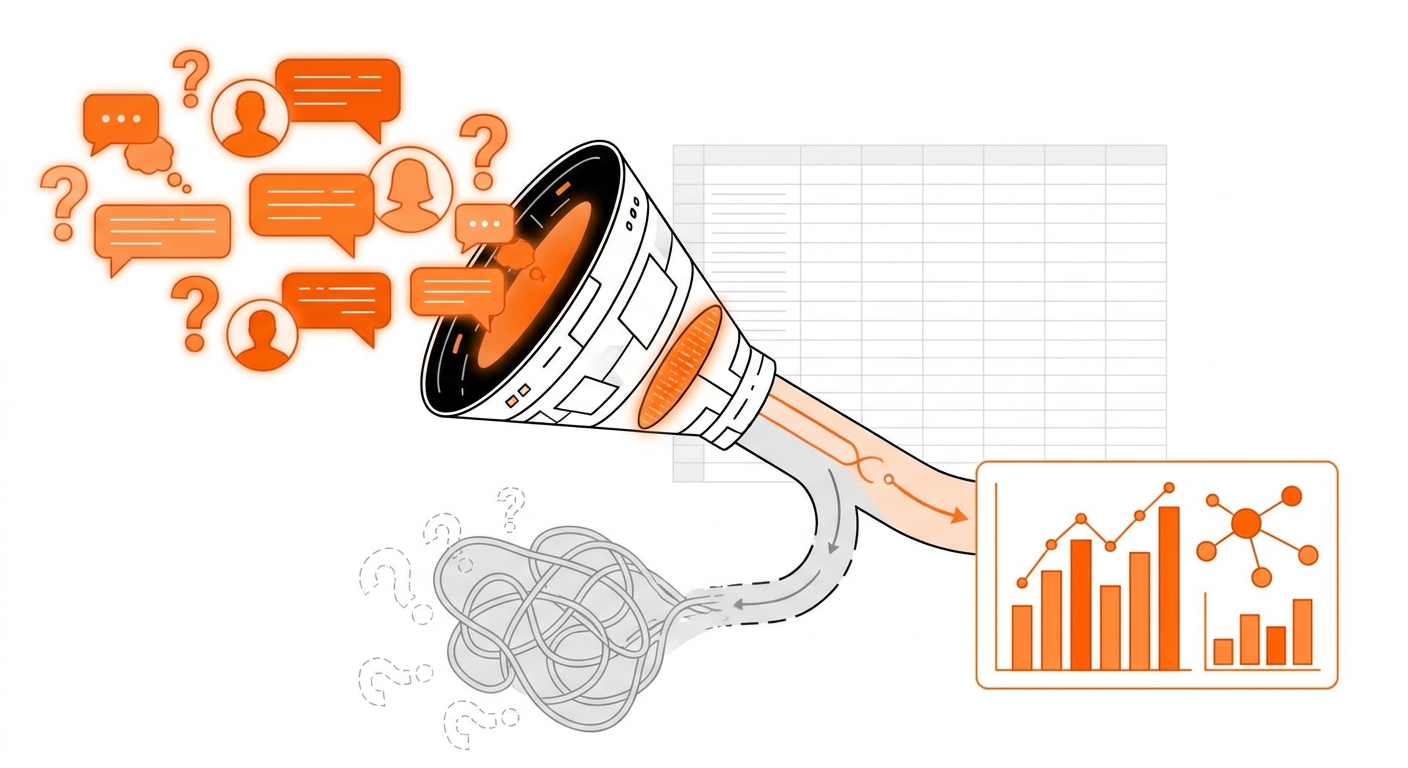
Build a prompt list for tracking brand mentions in AI search
Tracking is only as good as the prompts you track. If you test queries nobody types, you get clean data about nothing.
So open a spreadsheet and aim for 20 to 30 prompts. Add columns for the prompt, the buyer stage, and the AI engine you test it on.
- Pull real questions from sales calls, support tickets and Reddit threads.
- Add category prompts, such as "best invoice automation tools for small agencies."
- Add comparison prompts that name your competitors.
- Add problem prompts that describe the pain without naming any product.
Then write each prompt the way a buyer would type it into ChatGPT, in full sentences. Also check your Google Search Console keywords for phrasing ideas. Finally, freeze the list for a month so your results stay comparable.
Pull prompts from keyword data and Search Console
Start with what your site already ranks for. Open Google Search Console, go to Performance, and export your queries with impressions. Real buyers typed these words, so they make a reliable base for your prompt list.
Next, rewrite each query the way someone would ask a chatbot. "Invoicing software freelancers" becomes "best invoicing tool for freelancers in Germany". "CRM startup pricing" becomes "which CRM works for a five-person startup on a small budget".
Then check demand before you commit. A keyword tool that shows monthly volume and a 12-month trend tells you which topics are growing. Pick prompts with steady or rising demand and drop the ones that are fading. Aim for 15 to 20 prompts, enough to spot patterns without drowning in data. If you need a starting point, read our guide to keyword research for small B2B sites.
Cover every funnel stage
Split your tracking prompts into three groups. That way you see where AI search names you and where it skips you. Each group matches a different buyer mindset.
- Top of funnel questions, such as "What is generative engine optimisation?" or "How do small SaaS teams get found in ChatGPT?"
- Comparison prompts, such as "Your brand vs a competitor" or "Which AI SEO tools suit a two-person team?"
- Best tool for X prompts, such as "Best tool for tracking AI citations under €100 a month."
Comparison and buying prompts give the clearest revenue signal. Because the buyer already knows the problem, a mention here sits close to a trial signup. Awareness prompts show reach, but they rarely show intent.
A workable mix is 8 awareness prompts, 10 comparison prompts and 10 buying prompts. So you track 28 prompts, enough to spot patterns without drowning in data. For help mapping questions to stages, see TOFU, MOFU and BOFU content planning.
Manual tracking of brand mentions in AI search with ChatGPT, Claude and Perplexity
The free method is the simplest of the best ways to track brand mentions in AI search. Write 30 prompts your buyers would ask, such as "best invoicing tool for freelancers in Germany". Run each one in ChatGPT, Claude and Perplexity, then note whether your brand appears and which competitors do.
Answers change between runs. So run every prompt three to five times and log each result in a spreadsheet: prompt, tool, date, mentioned or not, position and cited source. Use a logged-out or fresh session each time, because chat history and account memory skew results.
The limits are real. Expect one to two hours a week for 30 prompts. Results are a sample, not a ranking, and trends only show after several weeks of data. Still, it costs nothing and shows where your AI search visibility stands today.
Set up a weekly spreadsheet for tracking brand mentions in AI search
A spreadsheet is enough to start tracking brand mentions in AI search. Add one row per prompt per engine, with these columns:
- Date
- Engine
- Prompt
- Brand mentioned (yes or no)
- Position in the answer
- Cited URL
- Competitors named
AI answers change between runs, so a single result tells you little. Run each prompt three times in a fresh chat. Then record the majority result. If your brand appears in two of three runs, log "yes."
Pick 10 to 15 prompts your buyers would actually ask, and check them on the same day each week. Because the sheet builds a history, you can see which pages earn citations over time. Our free brand monitoring template already has these columns set up.
Record the sources cited in AI search answers
Every answer in Perplexity comes with numbered source links. ChatGPT and Google AI Overviews show citations too, though less prominently. Those URLs show which pages and third-party sites the engines trust in your category.
So copy them into a spreadsheet after each prompt check. Log the URL, the domain, the engine and the date. After a few weeks, patterns appear.
Watch for sources that show up again and again:
- Review sites such as G2 or Capterra
- Directories and "best tools" roundups
- Competitor blog posts and comparison pages
Each repeat source is a target. Pitch the review site for a listing, and ask the roundup author to add you. Then write your own content to compete with the cited competitor pages. Because the engines already cite these pages, a presence there raises your odds of being named.
Track brand mentions in AI search using analytics and monitoring tools
Start by checking your existing analytics for referral traffic from chatgpt.com and perplexity.ai. Look at Search Console for impressions on queries showing AI Overviews. This tells you which pages get clicks. It won't catch the 80% of AI answer queries that end without one.
Mid-priced monitoring tools fill that gap, and they rank among the best ways to track brand mentions in AI search once manual checks get tedious. They send prompts to AI engines and report whether your brand appears in the answers. Enterprise platforms offer more detailed reporting, but they require long onboarding that's built for large teams, not solo founders or small teams of 1 to 10.
Pick based on what matters most. For more options, see AI SEO tools compared for small teams.
- Monthly cost
- How many prompts each tool monitors
- Which AI engines it covers: ChatGPT, Perplexity, Google AI Overviews, and others
- Whether you can export your data
- How long setup takes, ideally under a day
Check analytics for AI referral traffic to track brand mentions
Most analytics tools already log visits from AI systems. Open your acquisition or referral report and filter by source domain.
- chatgpt.com
- perplexity.ai
- claude.ai
- gemini.google.com
- copilot.microsoft.com
Older sessions may show as chat.openai.com. Include that in your filter. In Google Analytics 4, use a regex filter like chatgpt|perplexity|claude|gemini|copilot to catch all of them in one query.
Numbers will be small. Most AI answers don't generate clicks, so a brand can appear in answers frequently but still show only a few referral sessions. What matters is how often you're cited.
Each month, note your referral session count from AI sources. Compare it to your manual log of brand mentions in AI answers. Growing mentions with steady sessions is the normal pattern.
Measure share of voice and answer quality in AI search brand mentions
A log of prompts and answers only helps once you turn it into numbers. Start with mention rate: how many prompts showed your brand, divided by total prompts run. If you ran 30 prompts and your brand appeared in 12 answers, your mention rate is 12 ÷ 30 = 40%.
Run the same count for two or three competitors. Your share of voice is your mentions divided by all tracked brand mentions. The math stays simple enough to redo in a spreadsheet each month.
Score answer quality for each mention:
- Is your product description correct?
- Does the answer link to your site?
- Are you listed first or at the end?
Fix incorrect descriptions first; they cost you buyers directly. Then publish content around the prompts where you are absent.
Calculate brand mention rate and share of voice for tracking AI search mentions
Mention rate is the share of prompts where an AI engine names your brand. Divide prompts where you appear by prompts you ran. Appear in 10 of 40 prompts and your rate is 25%.
Share of voice compares you with rivals. Divide your mentions by all brand mentions in those answers. If answers name brands 80 times and 10 are yours, your share is 12.5%.
Track both by engine (ChatGPT, Perplexity) and by funnel stage (broad questions to buying prompts). Engines cite different sources, so one number hides your weak spots. Strong results on broad questions matter less if buyers never see you when they decide. To tie these numbers to revenue, read how to measure content ROI without an analyst.
Check sentiment and factual accuracy
Finding a mention is half the job. Read what the AI says about you. ChatGPT, Claude and Perplexity sometimes state the wrong price, list features you don't offer or place your company in the wrong country.
Flag every error in your tracking log. Note the engine, the prompt, the wrong claim and the date. Then trace the claim to its source. Check your pricing page, About page and product pages first, since outdated copy there is usually the cause.
Also compare your site with third-party profiles like G2 and LinkedIn. AI engines pull from multiple places, so conflicting facts produce conflicting answers. Use the same company name, location, pricing and feature list everywhere. Clear, consistent facts reduce wrong answers over time. After a few weeks, re-run the same prompts and check whether the error is gone.
Track competitor brand mentions in AI search answers
Tracking your own mentions only shows you what you are missing, not why. When ChatGPT lists two rivals and leaves you out, the reason is in their content structure. Your own tracking won't reveal it.
For each prompt, note which competitors appear and which of their pages get cited. A simple spreadsheet with columns for prompt, engine, competitor, and URL is enough. After a few weeks, you'll spot patterns. One comparison page might dominate citations. Another competitor might own all mentions for a specific angle.
Also track how often each competitor publishes. A rival posting weekly on a topic you skip is a keyword gap. Run a competitor content gap analysis on those areas to find what they are covering that you aren't.
RankRealizer alerts you when competitors publish new content and ranks their top articles by impressions. You can generate a counter-article with a single click.
Turn gaps in brand mention tracking into citable AI search content
Tracking only works when it changes what you publish. Open your log and pick one gap per page. If ChatGPT names three competitors for "project reporting tool for agencies" and leaves you out, write that article.
Lead with the answer, add a short FAQ, and use real numbers. Pages with structured lists, quotes and statistics rank 30-40% higher in AI visibility. See how to write content AI engines cite for more on the structure.
Then verify the page can rank on Google. If Google can't rank you, AI won't cite you. The overlap between Google's top 10 and AI citations fell to 17-38%, so you need both. RankRealizer builds FAQ schema and answer-first structure into every article to help with that.
Write answer-first pages with structure for AI search brand mention extraction
Put the answer in the first paragraph. AI engines pull short, self-contained passages. A page that buries its point gets skipped. Support the answer with detail further down.
Structure matters as much as wording. Pages with structured lists, quotes and statistics rank 30-40% higher in AI visibility. Use bullets to break up long text, name your sources, and add real numbers.
- Add FAQ schema for AI citation with short question and answer pairs.
- Mark each post with Article schema so engines can read the page type and date.
- Include author schema with a name and role to support E-E-A-T.
Tracking mentions only matters when your pages are built to be cited. RankRealizer includes all of these elements in every article by default.
Where RankRealizer fits in the routine
RankRealizer handles the publishing side. It's a GEO tool that writes articles based on your Knowledge Base, with FAQ schema and answer-first structure built in. Every article launches structured for AI citation.
It also covers part of the measuring. The dashboard shows AI impressions, AI clicks, ranked keywords and average position. Compare those numbers to your own checks when you decide on the best ways to track brand mentions in AI search. RankRealizer doesn't track mentions inside ChatGPT prompts, so keep manual prompt checks as part of your routine.
Plans start at EUR 50 per month. Pay-per-use is EUR 5 per article. The free trial gives you 3 articles without a credit card.
A 30-day routine for tracking brand mentions in AI search
You do not need a paid dashboard to start. A simple monthly routine covers the best ways to track brand mentions in AI search, and it takes about two hours a week.
First, pick 10 prompts your buyers would ask ChatGPT, Perplexity and Google AI Overviews. Then run them on the same day each week and log the results in a spreadsheet.
- Week 1: Run all 10 prompts. Record whether your brand appears, which competitors appear and which pages get cited.
- Week 2: Publish one article that answers your weakest prompt, with the answer in the first paragraph and an FAQ section.
- Week 3: Rerun the prompts and compare them against week 1.
- Week 4: Check impressions and ranked keywords in Google Search Console, because AI engines rarely cite pages Google ignores.
This week, write your 10 prompts into a spreadsheet and run them today. That is the first step in any of the best ways to track brand mentions in AI search, and it comes before you change anything on your site.
Weeks 1 and 2: establish baseline and build your prompt list for tracking brand mentions
Start with a spreadsheet. Every result you track later gets compared against what you record in these two weeks.
- Days 1 and 2: write 25 prompts a buyer would type, such as "best invoicing tool for freelancers in Germany". Mix category, comparison and problem questions.
- Day 3: run all 25 prompts in ChatGPT, Claude and Perplexity. Use a fresh chat each time.
- Days 4 and 5: log whether your brand appears, which competitors appear, and which sources each answer cites.
- Days 6 and 7: open Google Search Console and your analytics. Note impressions, top queries and referral visits from chatgpt.com and perplexity.ai.
Then repeat the full run in week 2. Because AI answers change between sessions, two runs give you a fairer baseline than one.
Also look at the cited sources. They show which content formats AI engines pick up in your category.
Weeks 3 and 4: publish content and track brand mentions again to compare results
Now fix the gaps. Pick the two to four prompts where competitors get named and you don't, then publish one article for each. Answer the question in the first paragraph, add a short FAQ, and include specific numbers, because AI engines quote pages they can lift clean answers from.
At day 30, re-run the exact same prompts in the same tools. Change nothing, or the comparison means nothing. Then record two numbers for each prompt:
- Mention rate: the share of runs where your brand appears.
- Share of voice: your mentions divided by all brand mentions in those answers.
Keep expectations realistic. New content can take weeks to show up in AI answers, so this first re-run sets a trend rather than a verdict. If a prompt has not moved, check the page before you rewrite it. A content refresh schedule for decaying posts also keeps older pages current.
Finally, decide which prompts to add. Drop any that no buyer would plausibly ask, and add new ones from your latest sales calls.
Frequently Asked Questions
What are the best ways to track brand mentions in AI search?
Start with a fixed list of 15 to 20 buyer questions and run them in ChatGPT, Perplexity, Claude and Google AI Overviews. Then log whether your brand is named, cited with a link, or missing. Also check your analytics for referral visits from AI platforms. Together these give a small team a clear baseline without a big budget.
Can I track brand mentions in AI search manually, without a paid tool?
Yes. Put your prompts in a spreadsheet with columns for platform, date, whether you appeared, and which competitors did. Because AI answers change between runs, repeat each prompt two or three times. This takes about an hour a week, which is realistic for a founder running a team of one to ten.
Which AI search platforms should I track brand mentions on first?
Begin with ChatGPT, Perplexity and Google AI Overviews, because that is where buyers research before they visit a website. Google matters because 48% of tracked queries now show an AI Overview. Add Claude once your first round of tracking is running.
How do I know if AI search is sending me traffic?
Clicks undercount your visibility, because more than 80% of AI answer queries end without a click. So look at referral sources in your analytics, and watch branded search volume in Google Search Console. RankRealizer's dashboard also shows AI impressions and AI clicks next to your ranked keywords and average position.
How often should I check my brand mentions in AI search?
Check your core prompts once a week and review the trend once a month. AI answers shift often, so a single check tells you little. Keep the prompt list stable so you can compare results over time, and add new prompts only when your product or audience changes.
What should I do if AI search never mentions my brand?
First check your Google rankings, because if Google can't rank you, AI won't cite you. The overlap between Google's top 10 and AI citations has dropped to 17-38%, so ranking alone is not enough. Then publish answer-first articles with FAQ schema and clear structure. For ideas on where to start, see our guide to GEO content structure.


.png)