
%2001%201.png)


Reviews and SEO: Why Your G2 Page Now Outranks Your Homepage in AI Answers
Reviews and SEO: The Signal Most Multi-Brand Teams Underuse
You are running SEO across five, ten, maybe twenty accounts. Titles optimised. Internal links mapped. Link building briefs out the door. Meanwhile, a G2 comparison page and a Capterra listing you have never touched are shaping what Google ranks for your category terms and what ChatGPT says when a buyer asks for recommendations.
Here is the argument, plainly: review platforms are one of the highest-density sources of the exact content format AI engines pull from. Structured lists. Direct customer quotes. Side-by-side comparative statements. Ratings expressed as numbers. Pages built with structured lists, quotes and statistics show 30-40% higher AI visibility. Review content is that, by default, at scale, refreshed constantly.
The timing matters. Overlap between Google's top 10 and AI citations has fallen from 75% to somewhere between 17% and 38%. Over 80% of AI answer queries end without a click. Ranking well no longer guarantees you are in the answer, and being absent from the answer means being absent from the consideration set entirely. This is the core of how generative engine optimisation actually works, and review content sits right in the middle of it.
The opinion: treating reviews as a reputation task owned by customer success, sitting outside your SEO roadmap, costs you visibility you have already earned. It is measurable content. It should be on your plan.
The three sections below cover what business reviews do to organic performance, how AI engines actually use them, and how to work them into a multi-account content cadence without adding headcount.
What Business Reviews Actually Do For Organic and AI Visibility
Business reviews do three specific jobs, and none of them are about trust in the abstract.
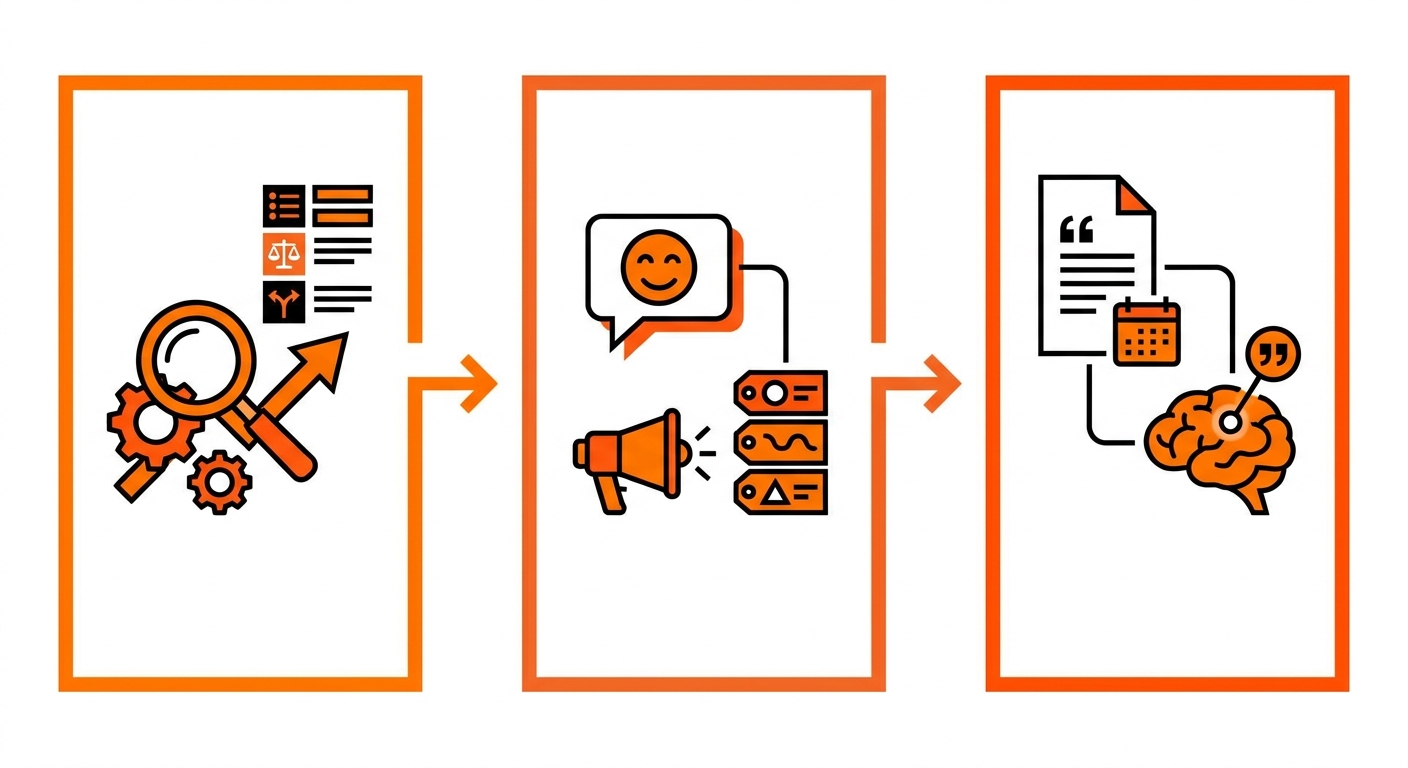
They create third-party pages that rank for high-intent queries. A G2 or Trustpilot listing targets "alternatives to [vendor]" and "[vendor] vs [vendor]" better than your own comparison page, because it carries independent signals Google weights heavily on commercial queries. Search a branded alternative query in your category and count how often a review directory sits above the vendor's own page. Now consider that 80% of AI answer queries end without a click. The buyer forms an opinion from that listing and never visits either site.
They supply real buyer language. Reviews describe problems in the words your prospects type, not the words your product team uses. That is free keyword and messaging research.
They give AI engines quotable material. Dated, attributed, named-author content is exactly what ChatGPT and Perplexity prefer to cite.
On E-E-A-T: review content carries first-hand experience signals you cannot write into your own copy. Self-published claims are not the same evidence class, which is consistent with how Google describes experience and trust in its helpful content guidance.
Where review content shows up in AI answers
Review sources dominate four query types: best tool for X, alternatives to Y, is Z worth it, and pricing comparisons. The counterweight is answer-first content on your own domain with FAQ schema built for AI citation. Funnel-stage tagging decides what gets built: BOFU for comparison and pricing queries, MOFU for "is it worth it", TOFU for category education.
Practical implication for a small team: you cannot write past a weak review profile. You can mine reviews for briefs, objections and FAQ angles.

Turning Review Insight Into Content You Can Publish at Scale
Nobody on your team doubts that reviews matter. The blocker is capacity. Writing one SEO article manually takes four to eight hours. Two people covering fifteen client accounts cannot absorb that math, no matter how good the insight is.
So treat review mining as a production input, not a research project. A repeatable version looks like this:
Pull recurring objections from G2, Capterra and Trustpilot, keeping the reviewer's exact phrasing.
Group each objection into a keyword cluster rather than a single term.
Assign a content type: comparison for switching intent, how-to for implementation doubts, listicle for category research.
Tag a funnel stage, TOFU, MOFU or BOFU, so the brief knows its job.
That list is now a queue an automated pipeline can work through. In RankRealizer, each client gets its own Knowledge Base holding brand voice, ICP definition and forbidden words, so account nine does not sound like account three. Keyword discovery runs against Google Keyword Planner and Clickstream data, plus Search Console for terms the site already ranks for. Generation runs nine steps: SERP competitor analysis, content brief with content gap extraction, outline, body, FAQ section with schema, SEO scoring pass, originality check, meta details, cover image.
The tool was built with RhineWeb and SaphirSolution GmbH, two SEO agencies, which is why the output is structured for ranking rather than just publishing. Competitor monitoring alerts you when a rival ships new comparison content, so you can answer it the same week. More on scaling content across client accounts separately.

What This Means For Your Next Quarter
The teams keeping their SEO budget in 2026 are not the ones showing a nice ranking chart. They are the ones reporting Google impressions next to AI impressions and AI clicks, in the same dashboard, in the same review meeting. Two numbers, one story. And reviews and SEO happen to be one of the few inputs that move both at once, because the same customer language that earns trust on a G2 page is the language AI engines pull when someone asks for a recommendation in your category.
Three things worth doing in the next 30 days:
Audit the third-party review pages that rank for your brand and category queries. Search your brand plus "reviews", then your category plus "best tools". Note who owns those results.
Pull the ten most repeated objections from those reviews and turn each into a content brief. That is your backlog for the quarter, built from real buyer language rather than a keyword tool alone.
Set a cadence you can hold without hiring. Two articles a week, published consistently, beats a burst of twelve and then silence. Automated publishing schedules make that part boring, which is the point.
Honest limits: automation will not fix a thin review profile, and it will not decide what deserves publishing. That judgement stays with you.
Testing costs little. Three free articles, no credit card. After that, EUR 5 per article, against the EUR 2,000 to 5,000 monthly retainer most European agencies charge.
Chris Roth puts it plainly: if Google cannot rank you, AI will not cite you.
Frequently Asked Questions
How are reviews and SEO actually connected?
Reviews feed the signals search engines use to judge whether a business is real and worth surfacing. Ratings, review volume and recency influence local pack placement, and review text often contains the exact language buyers type into search. For B2B SaaS teams, G2 and Capterra profiles frequently outrank your own comparison pages, so the review layer becomes part of your branded search footprint whether you manage it or not.
Do reviews and SEO matter for AI search visibility too?
They matter more there than in classic search. ChatGPT, Perplexity and Google AI Overviews lean heavily on third-party sources when someone asks for a recommendation in a category, and review platforms are among the most cited. Pages with structured lists, quotes and statistics show 30 to 40 percent higher AI visibility, which is why review-rich comparison content gets pulled into answers. The overlap between Google's top 10 and AI citations has dropped to between 17 and 38 percent, so covering both layers is no longer optional.
What role do business reviews play in ranking a local or regional B2B site?
Business reviews on Google Business Profile, Trustpilot and industry directories act as trust signals that support rankings for location-modified queries. Steady review flow beats a burst of ten reviews in one week, and replies add fresh, keyword-relevant text to the profile. If you manage several brands or client accounts, treat review cadence like publishing cadence: set a schedule and keep it running.
Should we build content around review keywords?
Yes, and it is usually underserved. Terms like "[competitor] reviews", "[category] tools compared" and "is [product] worth it" sit close to the buying decision and convert better than top-of-funnel traffic. Comparison and listicle formats work well here because AI engines extract them cleanly, especially when each section answers the question in its first paragraph.
How do small teams keep up with review-driven content across multiple brands?
Manual production does not scale when one person covers SEO for five or twenty accounts, since a single article takes four to eight hours to write properly. The practical fix is a per-account knowledge base that stores brand voice, ICP and forbidden words, then generating and scheduling articles from that context. RankRealizer runs each article through a nine-step process including SERP analysis, SEO scoring and a quality check, with FAQ schema built in so the output is ready to review rather than rewrite.
What should we measure to prove reviews and SEO are working together?
Track impressions and average position alongside AI impressions and AI clicks, since those tell different stories now. Add review velocity per profile and branded search volume as supporting metrics. If AI impressions climb while classic clicks stay flat, you are being cited in answers that end without a click, which still counts as visibility with your buyers.




.png)