%2001%201.png)

Getting Cited in ChatGPT Search: A Workflow That Scales Across Client Accounts
Getting cited in ChatGPT search takes two things. Ranking on Google gets your page into the candidate pool. Passage-level structure gets you quoted: a direct answer in the first paragraph under each H2, FAQ schema, named entities and stated figures. Miss the second half and strong rankings still produce zero citations.
That gap is now measurable. Overlap between Google's top 10 and AI citations has fallen from 75% to between 17% and 38%. If you are running 5 to 20 client domains with a team of two or three, you cannot close that gap page by page. Below is the per-domain workflow that fixes it, plus a 30 minute citation audit you can run monthly.
How ChatGPT search decides which pages to cite
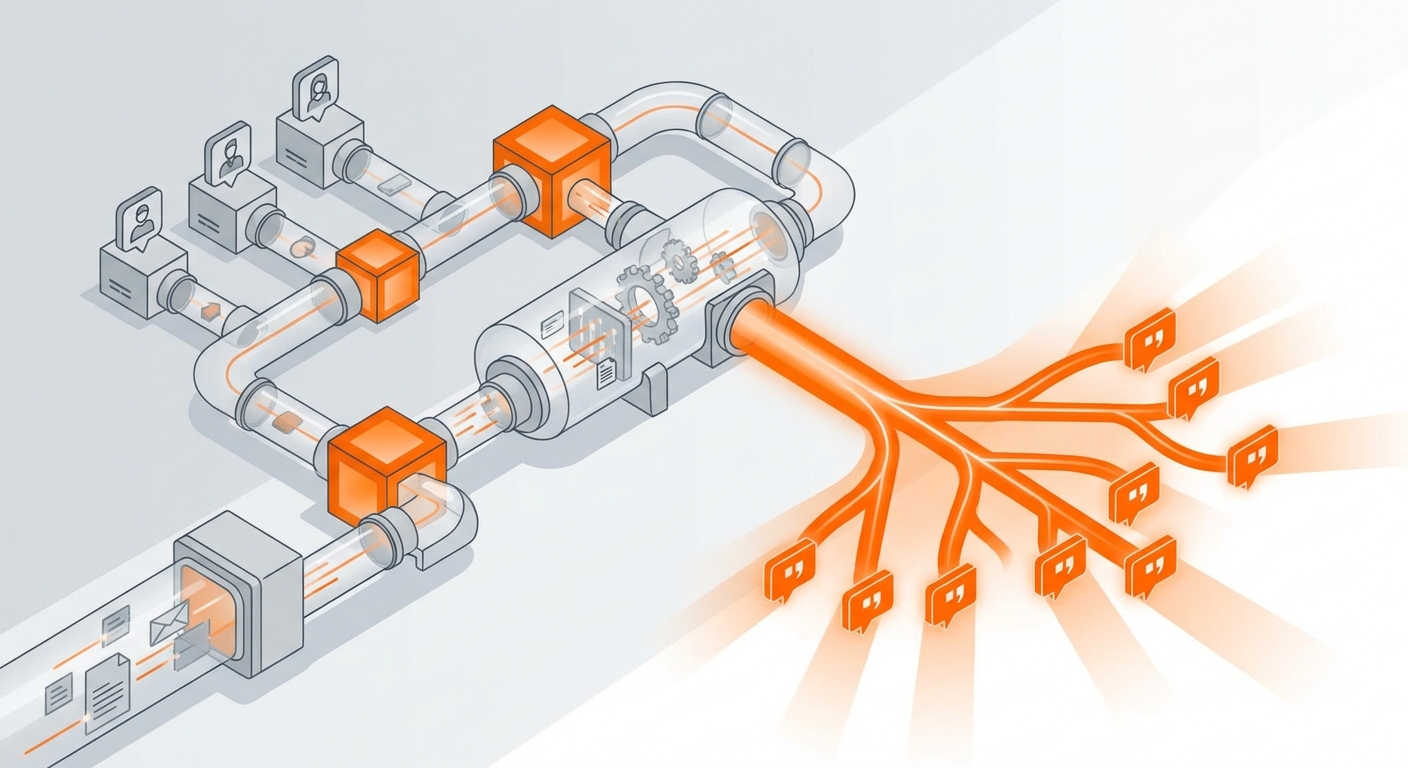
ChatGPT search takes a prompt and breaks it into several smaller searches. It pulls back a small set of URLs. Then it lifts short passages from the pages that answer the question directly. That is the whole mechanic. Three steps, and each one filters you out if your page is not built for it.
Query fan-out: one buyer prompt becomes four to eight sub-queries. "Best GEO tool for agencies" splits into pricing, multi-client support, comparisons, and reviews. You compete on all of them, not one head term.
Retrieval: a mix of indexed results and live page fetches builds the candidate pool. Small pool. Usually under twenty URLs before filtering.
Extraction: the model finds a quotable chunk. If it cannot isolate one, it moves to a page where it can.
So if you manage SEO across several sites, the unit of visibility is a passage, not a page. Passage-level retrieval changes the math. A page can rank third on Google and still get skipped. If the real answer sits in section four under a soft subhead, a thinner page that answers in paragraph one wins.
The data backs this up. Overlap between Google's top 10 and AI citations dropped from 75% to 17-38%. And 80%+ of AI answer queries end without a click, so an uncited brand is invisible, not just under-clicked.
Chris Roth's thesis still holds: if Google cannot rank you, AI will not cite you. Crawlability, authority and topical depth are still the entry ticket. What changed is the second half. Ranking gets you into the candidate pool, and structure gets you quoted. If the foundation is still shaky, start with how to rank on Google before chasing AI citations.
What a citable passage looks like
Short, self-contained, 40 to 60 words. Names the entity. Carries a number or a date.
Before: "There are many factors to consider when choosing a tool for AI visibility, and the market has changed significantly over the past few years."
After: "RankRealizer is a GEO tool that builds FAQ schema, answer-first structure and E-E-A-T signals into every article by default. Plans start at EUR 50 per month for 15 articles. Pay-per-use is EUR 5 per article, which no other tool in the category offered as of 2026."
Why your top-three rankings are not transferring
Four structural problems, all fixable without rewriting the article:
Answer buried below the fold. Move the direct answer into the first paragraph under each H2.
No FAQ schema. Schema-ready Q&A pairs give extractors a clean block to lift.
Brand entity not stated. Use the full brand name in the passage, not "we" or "the platform".
Thin author signals. Person and Article schema tell the model who wrote it and why that matters.
Google AI search: what changed in the SERP and what to track
Treat Google AI search as its own surface, not a new SERP feature. It has its own selection logic, its own citation list, and its own reporting problem. Around 48% of tracked queries now show a Google AI Overview. That means a large share of your impressions never reach a blue link. Position 4 with a strong snippet used to mean traffic. Now it can mean the answer got built above you and the user left.
Three things belong on your task list this quarter:
Identify which of your ranking keywords trigger an AI Overview. Pull your top queries from Search Console. Then check them by hand or with a rank tracker that flags AI Overview presence.
Check whether your domain appears in the citation list. Ranking on page one and being cited are two different outcomes. The overlap between the Google top 10 and AI citations has dropped from 75% to somewhere between 17% and 38%.
Split your reporting. Classic clicks in one column, AI impressions in another. Reporting them as a single number hides which half is growing.
Google AI search pulls heavily from pages it already trusts for a topic cluster. Topical depth and internal linking still carry weight, so topic cluster planning is not optional. What decides whether you make the citation list is the on-page format: an answer in the first paragraph, clean H2 to H6 structure, FAQ schema, lists, and stated figures. Trust gets you considered. Format gets you quoted.
Search Console is the practical data source here, including AI Overviews reporting in Search Console. One dependency people skip: a page cannot be cited before it is indexed. RankRealizer submits every article to Google Search Console on publish, which shortens the gap between going live and being eligible.
Keyword types that trigger AI answers
Definitional, comparison, how-to and list queries trigger AI answers most often. Transactional and branded queries trigger them far less. The user already knows what they want, so Google sends them to a page.
Map your content calendar to that split. Tag articles TOFU, MOFU or BOFU so the team can see which pieces chase AI citations and which chase clicks. TOFU definitional and how-to content is your citation play. BOFU comparison and pricing pages are still a click play. Measure them against different targets. If keyword selection is the bottleneck, our guide on finding keywords without the overwhelm covers the shortcut.
Artificial intelligence SEO: the page structure that gets extracted
Artificial intelligence SEO is not a new discipline. It is the same technical foundation you already run, plus a formatting layer that makes your content easy to lift, quote and attribute. That is good news for a team with existing SEO knowledge. You are adding extraction formatting, not rebuilding your process. For a wider view, see our artificial intelligence SEO guide.
The build spec is specific. Every H2 opens with a direct answer in the first paragraph, before context. Heading hierarchy runs clean from H1 to H6, one idea per section, so a retrieval system can isolate a passage without dragging in unrelated text. Every article closes with a question and answer block using FAQ schema markup, because question-shaped markup matches how AI engines retrieve queries.
Article schema plus Person or Author schema carry your E-E-A-T signals. Statistics, direct quotes and structured lists matter more than they used to. Pages carrying those elements show 30-40% higher AI visibility. Meta title, meta description and alt text still need doing properly, because the Google layer feeds the AI layer.
RankRealizer builds these in by default rather than as optional toggles. FAQ schema goes on every article. Answer-first structure is the writing standard, not a setting. Each draft gets a Yoast-style SEO score from 0 to 100 before publishing, plus a plagiarism and readability check.
A publish-ready checklist
One H1 per page, keyword placed naturally in the first 60 characters
Answer-first paragraph of 40 to 60 words directly under every H2
Clean H1 to H6 hierarchy, no skipped levels, one idea per section
FAQ block of four to six question and answer pairs, marked up with schema
Article schema plus Person or Author schema with a real named author
At least two cited statistics with a source and one direct quote
Two structured lists minimum, either ordered steps or comparison bullets
Entity mentions: product names, competitor names, categories and locations spelled consistently
Three to five internal links to related pages, anchored on descriptive phrases
Meta title under 60 characters, meta description under 155, alt text on every image
SEO score of 80 or above before anything goes to the publish queue
Where most AI-generated drafts fail
Read the G2 and Trustpilot reviews across the AI SEO category and the same line keeps appearing: needs editing before publish. That is the recurring third-party verdict, not our opinion.
The gap is rarely grammar. Drafts read fine. What is missing is structure: no schema, no answer-first opening, headings that wander across three ideas, and brand voice that could belong to any company in the category. Those are the parts an AI engine needs to cite you. They are also the parts a human editor ends up rebuilding by hand.
Running this across multiple brands and client accounts
Managing five to twenty domains with two or three people fails for one reason: every account gets treated as a fresh project. The fix is a repeatable workflow you run the same way per domain. Then automate the parts that do not need a human. Tooling for teams running more sites than they have people goes deeper on the setup side.
Build a Knowledge Base per brand or client. Website URL for the scan, uploaded documents (pitch deck, brand guide, product one-pager, sales script), a Target Client Definition covering job title, industry, company size and pain points, plus brand voice setup with forbidden words. Save your recurring instructions as presets so account number twelve takes ten minutes, not an afternoon.
Run keyword discovery per domain. Seed keyword in, hundreds of opportunities out, pulled from Google Keyword Planner and Clickstream data with volume, competition, CPC and 1-month and 12-month trends. Connect Search Console to see what each site already ranks for. Set country targeting for clients selling into multiple markets.
Generate on a fixed nine-step process. SERP competitor analysis across the top 10, content brief with gaps, outline, body sections, FAQ with schema-ready Q&A pairs, SEO optimisation pass, quality and originality check, meta title and description, cover image. Same sequence every time, every account.
Review in the block editor. Use the AI Assistant to edit with prompts instead of rewriting paragraphs by hand. Adjust meta details, regenerate the cover image, generate social captions for LinkedIn, Instagram, Threads, Twitter/X and Facebook while you are there.
Schedule and auto-publish. WordPress or Webflow, one, two or five articles per day, inside a publishing window and on active days you choose. Every publish gets submitted to Google Search Console automatically.
Layer competitor content monitoring on each client domain. You get alerts when a rival publishes, a view of their top articles sorted by impressions, and one-click counter-article generation. Role-based access and workspace management let you split review duties. A junior handles first-pass edits while you approve.
The economics are blunt. Writing one SEO article manually takes 4 to 8 hours. A European agency retainer runs EUR 2,000 to 5,000 per month. RankRealizer starts at EUR 50 per month, with pay-per-use at EUR 5 per article when a client account is unpredictable.
Keeping brand voices separate at volume
Saved ICP profiles, forbidden word lists and tone settings live per workspace, not in someone's head or a shared doc. Client A never inherits Client B's phrasing. That separation is the whole difference between output you approve and a queue of rewrites that eats the time you just saved.
Reporting on both surfaces without doubling the work
Your CMO or your client does not care which engine sent the lead. They care whether the spend produced visibility. So report both surfaces in one view, on one page, every month.
Here is the metric set worth tracking:
Total impressions from Google Search Console
AI impressions and AI clicks
Ranked keywords and average position
Articles published in the period
Citation checks against a fixed prompt list
The last one is the piece most teams skip. It is also the one that answers the question leadership actually asks. Run a manual audit. It takes 30 minutes.
Write 20 to 30 buying-intent prompts. Think "best X tool for Y", "alternatives to Z", "how do I solve [pain point]". Not brand names. Category questions.
Run the same list monthly in ChatGPT search and Perplexity. Same prompts, same order, same wording.
Log which brands appear in each answer and which URLs get cited.
Track the delta month over month. Appearances gained, appearances lost, competitors who moved in.
That spreadsheet is your AI citation tracking baseline. It costs you half an hour. In return it turns an abstract argument into a row of numbers someone can read.
Pair it with Search Console and the report starts telling a story. Indexing status and impressions are your leading indicators; they move first. Clicks and conversions lag; they move later. Citation appearances sit between the two. Show all three side by side and you stop defending a flat click chart in month two while impressions climb underneath it.
One more reframe for the reporting window. A single ranked article can bring in leads for three years. Judging content on a 30-day cycle measures the wrong thing. Report monthly, but set expectations against a 6 to 12 month curve. That shift alone does more for proving SEO ROI to leadership than any dashboard redesign.
Next step, in order:
Build the prompt list this week.
Fix the structure on your ten highest-intent pages. Answer-first openings, FAQ schema, clear headings.
Then decide whether to automate the rest.
If you want to check output quality before committing budget, RankRealizer gives you three free articles, no credit card. Publish them, watch what happens in both surfaces, then make the call.
Frequently Asked Questions
How does ChatGPT search decide which sources to cite?
ChatGPT search pulls from live web results, then extracts the passages that answer the query most directly. Pages that state the answer in the first paragraph, use clear H2 and H3 structure, and include FAQ schema get quoted more often. Pages that build context for 400 words first get skipped. Statistics, quoted sources and structured lists also help: pages with those elements show 30 to 40 percent higher AI visibility. If Google can't rank you, AI won't cite you, so the technical basics still matter.
Do my Google rankings carry over to ChatGPT search?
Less than they used to. The overlap between the Google top 10 and AI citations dropped from around 75 percent to somewhere between 17 and 38 percent. So a page can sit at position three on Google and never appear in an AI answer. You need to track both, and structure content for extraction as well as ranking.
What is the difference between Google AI search and ChatGPT search for B2B visibility?
Google AI search, meaning AI Overviews and AI Mode, sits on top of the classic SERP. It now appears on roughly 48 percent of tracked queries. It tends to favour pages that already have crawl and index signals plus schema markup. ChatGPT search behaves more like a research assistant. It rewards content that reads as a specific, sourced answer rather than a keyword-matched page. Reporting on both channels in one dashboard is how most SEO managers now justify spend to leadership.
How do I measure whether my content is showing up in AI answers?
Start with AI impressions and AI clicks as separate metrics from total organic impressions. More than 80 percent of AI answer queries end without a click. Then run manual prompt checks in ChatGPT and Perplexity for your category terms and note whether you or a competitor gets named. RankRealizer's dashboard tracks total impressions, AI impressions, AI clicks, ranked keywords and average position in one place, which saves rebuilding client reports by hand.
Does artificial intelligence SEO mean I need a separate content workflow?
No, but you need extra structure inside the workflow you already have. Practical artificial intelligence SEO means answer-first openings, FAQ schema on every article, Article and Person schema for E-E-A-T signals, and clean heading hierarchy. Bolting these on by hand after publishing is where small teams lose hours. Build them into the generation step instead. Schema markup for AI citation is the part most tools skip.
How can a small team publish enough to compete in ChatGPT search across multiple brands?
Volume alone will not get you cited, but inconsistent publishing will get you ignored. Writing one SEO article manually takes 4 to 8 hours. That does not scale across 5 to 20 client accounts with a team of two or three. RankRealizer sets up a separate Knowledge Base per client, with brand voice, ICP and forbidden words saved, then generates, scores and schedules articles per domain in one workflow. The free trial covers 3 articles with no credit card, so you can test the output on a real client brief first.




.png)